A PRACTICAL, NO-HYPE GUIDE TO EVERYDAY WELLNESS HABITS
GUIDE INDEX / PRODUCT VERIFICATION / PRESSPRIL
Product Verification · Update, September 29, 2026

PressPril: We Found the Real Sales Page — Here's the Full Panel, Every Price, and a Citation That Points to the Wrong Study

An earlier entry here reported that PressPril's plain homepage was an empty placeholder and that we couldn't locate an actual sales page. PressPril's real funnel lives at a separate, non-homepage address, and we've now read it directly: the ingredient panel, all three pricing tiers, the guarantee, the checkout processor, and the label's fine print. We also checked two of its scientific citations against PubMed ourselves — and found a genuine problem with both.

At A Glance

What PressPril actually is

Confirmed directly from the seller's own live sales page, September 29, 2026.

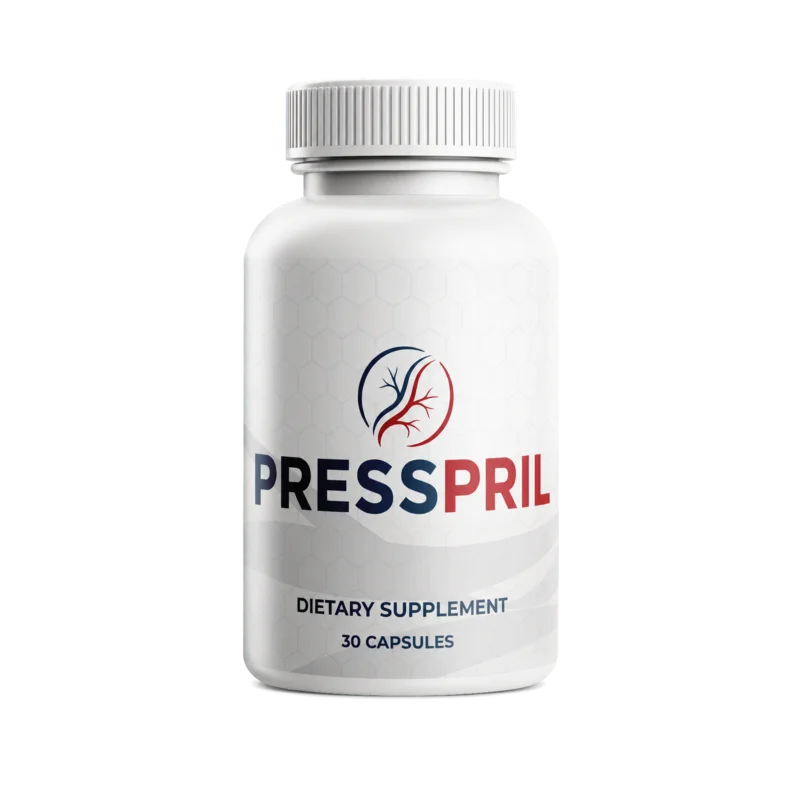
PressPril bottle, 30-capsule dietary supplement

Official product image, PressPril, sourced from the seller's own sales page.

Found at: a separate funnel address, not presspril.com's own homepage Marketed as: a nitric-oxide "blood pressure support" capsule, in the seller's own words Format: 1 capsule daily, 30 capsules per bottle Listed price: $49–$79 per bottle, depending on package Guarantee: 60-day money-back, per the seller's own page

The page's own title tag reads "PressPril — Nitric Oxide Blood Pressure Support," pitched at "adults over 45." It's a single long-scroll sales page rather than a conventional storefront — part of why checking presspril.com's own front door didn't turn it up the first time. More on exactly where it lives further down.

Ingredients

The full label, read directly

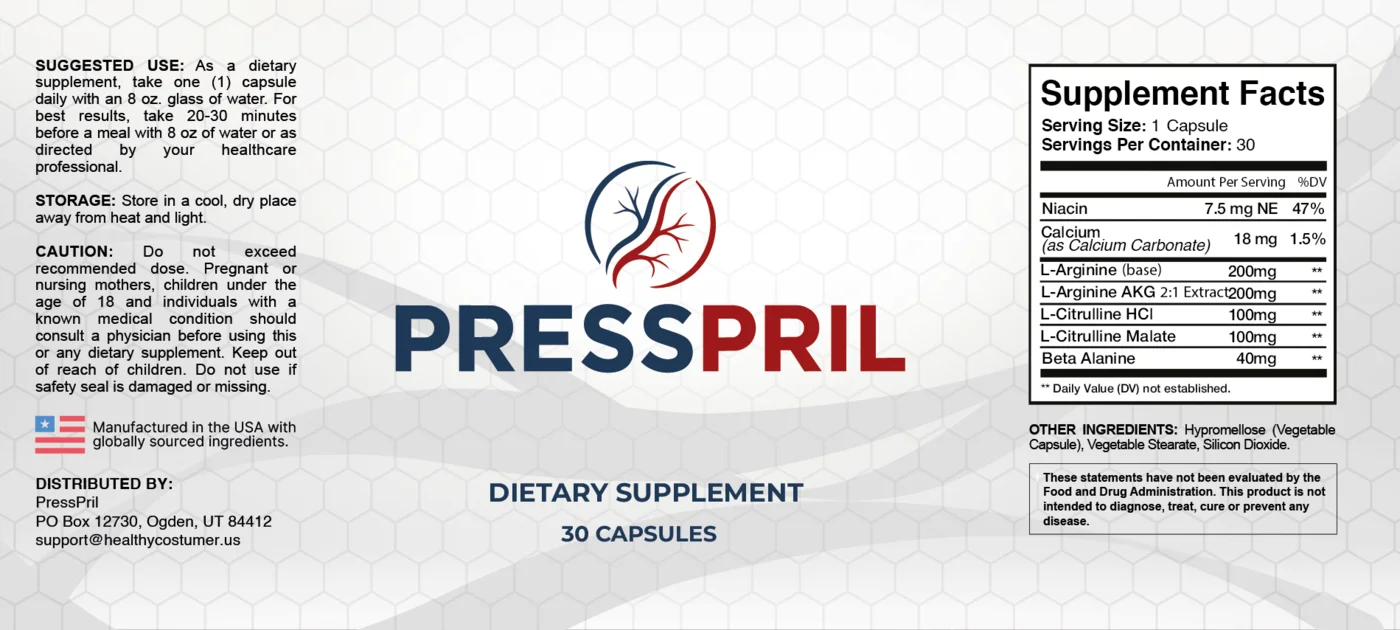
Unlike many entries in this guide, PressPril discloses an itemized Supplement Facts panel rather than a proprietary blend.

PressPril Supplement Facts label showing niacin, calcium, L-arginine, L-arginine AKG, L-citrulline HCl, L-citrulline malate, and beta alanine doses

Official product label, PressPril, read directly by us September 29, 2026.

Per capsule: Niacin 7.5 mg NE (47% DV), Calcium (as carbonate) 18 mg (1.5% DV), L-Arginine (base) 200 mg, L-Arginine AKG (2:1 extract) 200 mg, L-Citrulline HCl 100 mg, L-Citrulline Malate 100 mg, and Beta Alanine 40 mg — the last five carry no established Daily Value. Other ingredients: hypromellose (capsule shell), vegetable stearate, silicon dioxide. Suggested use is one capsule daily with 8 oz. of water, 20–30 minutes before a meal; the label cautions against exceeding the dose and tells pregnant/nursing users, anyone under 18, and anyone with a diagnosed condition to check with a physician first, echoing the sales page's own note about blood pressure medication, blood thinners, and nitrates. Itemized doses beat a hidden proprietary blend, but whether 100–200 mg of L-citrulline and L-arginine match the amounts used in the published research is a separate question, addressed below.

Price & Guarantee

All three pricing tiers, as listed

2 bottles (60-day supply): $79/bottle · $158 total, listed as reduced from $298 · plus shipping 3 bottles (90-day supply): $69/bottle · $207 total, listed as reduced from $447 · plus shipping 6 bottles (180-day supply, the seller's featured option): $49/bottle · $294 total, listed as reduced from $894 · free U.S. shipping

The seller's headline says three digital bonuses it values at $47, $57, and $37 come with the 6-bottle package — yet its own pricing cards print "3 Free Bonuses" and a "FREE USA Shipping" badge on all three tiers while still adding "+ Shipping" to the 2- and 3-bottle totals, so the page contradicts itself on what the smaller packages include. We haven't reviewed the bonuses' content. The "was" prices are the seller's own reference figures, not an independently confirmed market price. The seller states a "60-day 100% money-back guarantee" covering any reason for return, and a separate FAQ describes this as a one-time purchase with no subscription. That's the seller's claim to honor, not something we can enforce — save your confirmation email if you order. The page also runs stock-scarcity language ("Available Only While Supplies Last!"), which we'd treat as sales framing, not verified inventory data.

Transparency Check

The distributor line doesn't match its own label

A ZIP code that disagrees with itself

Beneath the label image, a caption reads: "Distributed for: PRESSPRIL, PO Box 12730, Ogden, UT 84404." The label graphic directly above that caption — same page, same image — prints "PO Box 12730, Ogden, UT 84412." Same box, same city and state, different ZIP, both on the same page. The two also list different emails: the caption's address is hidden behind an obfuscation script, and once decoded it sits at a "healthyconsumer.us" domain, while the label itself prints a plain address at "healthycostumer.us" — one letter apart, both third-party domains unrelated to presspril.com. Neither is necessarily sinister — PO Box mail-forwarding is common for this sales category, and copy errors happen — but it's worth knowing before assuming a single dedicated company sits behind the name. We haven't independently confirmed the box is shared with other brands in this specific pass, so we're not asserting that here.

Checkout runs through BuyGoods, a processor used broadly in this category. One more detail from the page's own source code: its checkout links carry a filled-in account number, but two BuyGoods helper scripts elsewhere on the page (a tracking script and a disclaimer loader) still contain a literal, unreplaced "REPLACE_ACCOUNT_ID" placeholder — a leftover suggesting a fast template launch, not a claim about the product. Separately, the FAQ states PressPril "is sold exclusively on our official website" and warns against buying elsewhere to avoid counterfeits; we can't verify that exclusivity claim, but treat any checkout domain other than presspril.com's own funnel with real skepticism.

Citation Check

We looked up every PubMed ID ourselves

The page cites eight named studies, ten times total (two in pull-quotes, eight in its numbered reference list). We checked each one directly against the National Library of Medicine's PubMed database. Six check out cleanly everywhere they appear. Two do not.

Right citation, wrong number, in the same paragraph as the right one

A pull-quote about L-citrulline cites "Yang HH... Nutr Metab (Lond). 2019;16:88," linked to PMID 31889977. That PMID is real, but it belongs to "X-ray microtomography and linear discriminant analysis enable detection of embolism-related acoustic emissions," published in Plant Methods — a study about detecting air bubbles in tree branches, unrelated to blood pressure. Further down the same page, its own numbered reference list cites the identical study correctly: "Yang HH... 2019;16:89," PMID 31889969, which we also checked and confirmed is genuinely the right paper on oral L-citrulline and blood pressure. The correct citation exists on the page — it's just attached to the wrong PMID in the pull-quote that makes the claim.

Wrong everywhere it appears — and we found what the real one should be

A second pull-quote cites "Houston M, Hays L... J Clin Hypertens (Greenwich). 2014;16(7):524-529," linked to PMID 24894381. The page's own numbered reference list repeats the identical, wrong PMID. We checked it directly: 24894381 belongs to a 2014 Journal of Fluorescence paper on DNA and amino-acid chemistry, titled "Is macromolecular crowding overlooked?" — unrelated to blood pressure. Searching PubMed directly by author name, we located the real Houston & Hays paper at PMID 24962851: its title, authors, journal, volume, issue, and pages match the sales page's own citation text exactly. The study PressPril cites is real and appears to say what the page claims — every instance of its PMID on the page just points to the wrong paper instead.

The other six citations — L-arginine meta-analysis research (Dong et al., 2011), two L-citrulline meta-analyses (Barkhidarian et al., 2019; Mirenayat et al., 2018), a citrulline metabolism review (Bahri et al., 2013), a citrulline cardiometabolic review (Allerton et al., 2018), and an endothelial dysfunction review (Konukoglu & Uzun, 2017) — all checked out exactly as cited.

What this does and doesn't tell you

A wrong PMID doesn't prove a claim false, and citation mix-ups on long sales pages often happen by accident, not by design. But it does mean two of the page's own "verify this" links, if clicked, land on unrelated science — tree branches, then DNA chemistry — instead of the blood-pressure research they're meant to support. That's a real, checkable accuracy problem in how the seller sources its own claims, separate from whether the ingredients have legitimate research behind them (several do, per the six citations that check out).
Where We Looked

Why the earlier check missed this

presspril.com's own homepage, and getpresspril.com, still load as generic placeholder pages — each title tag literally reads "Site hospedado automaticamente via Sistema de Deploy" (Portuguese for "site automatically hosted via a deployment system"), a hosting platform's stock message for a domain with nothing built at its main address. That part of the earlier entry was accurate, and still is. What we missed is that PressPril's actual sales page lives at a separate, non-homepage funnel path entirely — the kind typically reached via a specific ad click or referrer link rather than a guessed URL. Once we had that exact address, it loaded directly and consistently.

Bottom Line

A real, disclosed formula — with a sourcing error worth knowing about

PressPril is a real, currently live product sold through a standard direct-response sales page. Its Supplement Facts panel is itemized rather than hidden behind a proprietary blend, and six of its eight cited studies check out exactly as described against PubMed. Weigh that against a distributor address listing two different ZIP codes and two different contact emails on the same page, and a citation error that isn't a rounding mistake — one PMID sends a reader to a paper about tree branches, another, used twice, to a paper about DNA chemistry, instead of the blood-pressure research the page cites them for. Neither issue proves the ingredients don't do what the correctly-cited research suggests; it does mean the "verify it yourself" links don't all hold up. As with any supplement aimed at blood pressure specifically, talk to whoever manages your blood pressure care before starting, especially if you already take blood pressure medication, a blood thinner, or a nitrate.

This page reflects our own direct reading of PressPril's sales page and label, and our own direct PubMed lookups for the PMIDs discussed above, performed September 29, 2026. Sales pages, pricing, and formulas can change at any time without notice — always check the current page before ordering. Nothing on this page, including any ingredient or citation discussion, is intended to diagnose, treat, cure, or prevent any disease. This site participates in affiliate programs, but this entry currently contains no purchase or affiliate links; see our Disclosure page for details.

Sources

Everything above, so you can check it yourself

This site uses cookies for essential function and, with your consent, ad measurement. See our Cookie Policy.