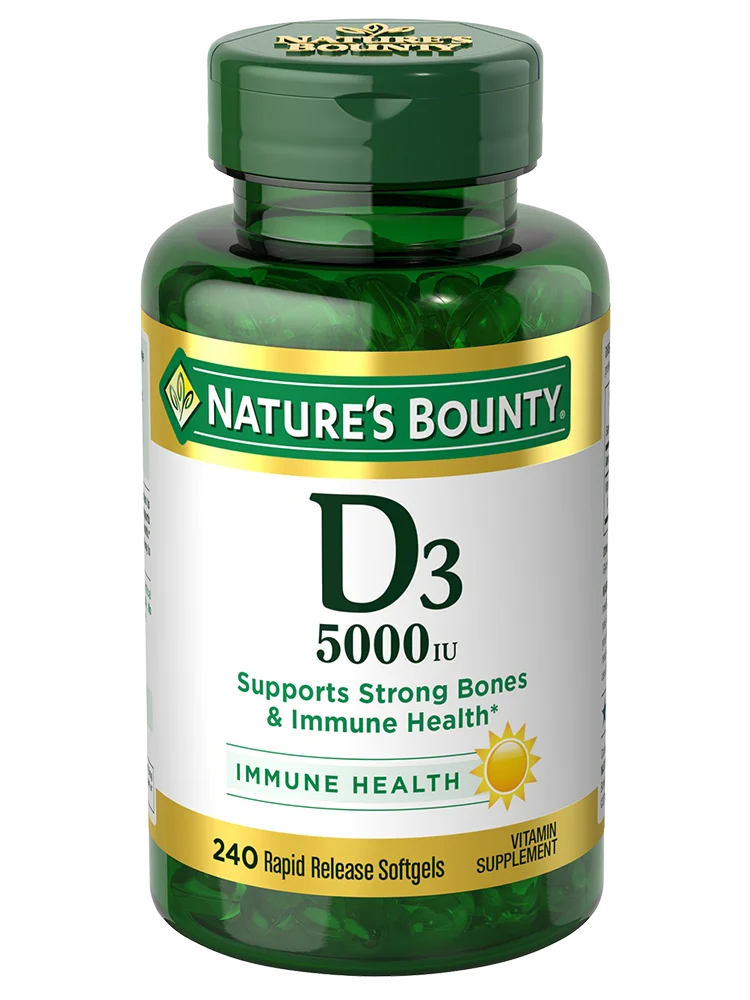
A high-dose, widely sold vitamin D3 softgel from one of the most recognizable names in the U.S. supplement aisle. Here's what's actually on the label, what the dose really means next to the FDA's own reference values, and — just as important — what "made in a GMP facility" does and doesn't tell you about quality.
As an Amazon Associate, The Living Well Guide earns from qualifying purchases. This doesn't change the price you pay. Full details in our affiliate disclosure.
Official product image, Nature's Bounty / Nestlé Health Science.
| Form | Rapid Release softgel |
|---|---|
| Dose per softgel | 125 mcg (5,000 IU) vitamin D3 / cholecalciferol |
| % Daily Value | 625% (of the FDA's 20 mcg / 800 IU adult reference Daily Value) |
| Suggested use | 1 softgel daily, preferably with a meal |
| Bottle sizes | 150, 240, 300, and 400 softgels (same formula, different counts) |
| Softgel shell | Soybean oil, gelatin, vegetable glycerin, corn oil |
| Free of | Artificial color, flavor & sweetener; sugar; gluten; dairy; wheat; yeast; fish; sodium |
| Non-GMO | Yes, labeled non-GMO |
| Third-party seal | None currently listed (see "What we found" below) |
| Manufacturer | Nature's Bounty, Inc., Bohemia, NY — part of Nestlé Health Science since 2021 |
Nature's Bounty markets this softgel around two everyday structure-and-function roles for vitamin D: helping the body absorb calcium — the same calcium already tied to bone strength — and supporting normal immune function, since vitamin D receptors sit on several types of immune cells. Those are standard, well-documented roles for vitamin D, and they're the same roles the ingredient plays whether it comes from this brand, another brand, or a few extra minutes of midday sun. Nothing about the product is marketed as treating or preventing a diagnosed condition, and this page isn't recommending it as one either — it's a daily maintenance nutrient, not a treatment.
Every dietary supplement legally sold in the U.S. is already required to be made under the FDA's current Good Manufacturing Practice rules (21 CFR Part 111) — an enforceable manufacturing-process standard the FDA can and does inspect. That's real, and it's what "GMP facility" refers to here. It's a different thing from an independent, per-product seal like USP Verified or NSF Certified for Sport, which involve outside lab testing of the actual finished bottle. As of this review, Nature's Bounty's Vitamin D3 5000 IU carries the former, not the latter — worth knowing, since the two get talked about as if they're interchangeable and they aren't.
Nature's Bounty has been sold since the 1970s and is now part of Nestlé Health Science, which acquired the brand from The Bountiful Company in a $5.75 billion deal completed in August 2021, alongside Solgar, Osteo Bi-Flex, and Puritan's Pride. This is a large, findable, publicly accountable manufacturer — not an anonymous private-label seller — which matters when you're trusting a label's stated dose.
125 mcg (5,000 IU) is more than six times the FDA's adult reference Daily Value of 20 mcg (800 IU), and above the NIH's general tolerable upper intake level of 100 mcg (4,000 IU) per day for long-term, unsupervised use. That's not a flaw in the product — a 5,000 IU softgel is a real, commonly stocked category, usually intended for short courses under a doctor's guidance for a known low level, rather than an everyday maintenance dose for someone with no diagnosed deficiency. More on this in the FAQ below.
The gluten-free, sugar-free, and non-GMO claims match what's printed on the actual supplement facts panel, and the softgel shell ingredients (soybean oil, gelatin, vegetable glycerin, corn oil) are the same soft-capsule base used across most of the mass-market softgel category — nothing unusual or undisclosed.
These statements have not been evaluated by the Food and Drug Administration. This product is not intended to diagnose, treat, cure, or prevent any disease.
The routine here is simple by design — this isn't a multi-step protocol, just a single daily habit worth doing correctly.
Vitamin D is fat-soluble, so it absorbs better alongside food that contains fat rather than on an empty stomach. The label's own suggested use — one softgel daily, with a meal — reflects this.
A dose this high is usually chosen because bloodwork already showed a low vitamin D level, on a doctor's recommendation — not guessed at. If you haven't had your level checked, a standard 600–800 IU multivitamin-range dose is the more conservative everyday starting point.
If a doctor recommended 5,000 IU to correct a deficiency, the usual pattern is a fixed course followed by a follow-up blood test — not an open-ended daily habit at that dose. Let the retest, not the calendar, decide whether to continue.
Vitamin D increases how much calcium your body absorbs from food. Combined with a thiazide diuretic (a common blood pressure medication), which already reduces how much calcium the body excretes, a high daily dose like this one can push blood calcium higher than either would alone — raising the risk of hypercalcemia. The same caution applies if you already take a separate calcium supplement, have hyperparathyroidism, or have kidney disease. It also applies if you're pregnant or nursing, per the label's own warning. None of this means the product is unsafe used correctly — it means "correctly" is worth confirming with a doctor first if any of the above applies to you.
The NIH Office of Dietary Supplements sets the general Recommended Dietary Allowance at 600 IU (15 mcg) per day for most people ages 1–70, rising to 800 IU (20 mcg) for adults over 70 — counting every source, food and supplements combined. A 5,000 IU softgel is well above that everyday baseline, which is normal for this category but is exactly why it's usually a targeted, doctor-guided choice rather than a default daily multivitamin swap.
For occasional or short-term use to correct a documented low level, it's a commonly used dose. For open-ended daily use with no known deficiency, it sits above the NIH's tolerable upper intake level of 4,000 IU (100 mcg) per day for most adults, and sustained intake above that level is associated with a real risk of hypercalcemia over time. That's a reason to have a plan (and ideally a bloodwork baseline) rather than a reason to avoid the product outright.
It describes how quickly the softgel shell breaks down after swallowing, not a difference in the vitamin D itself or how much your body ultimately absorbs. The 150-, 240-, 300-, and 400-count bottles are the identical 125 mcg (5,000 IU) formula — the only thing that changes between them is how many softgels you're buying at once.
Sources: NIH Office of Dietary Supplements, Vitamin D fact sheet for health professionals; FDA Current Good Manufacturing Practice regulations, 21 CFR Part 111; FDA Reference Daily Values, 21 CFR 101.9; Nature's Bounty product listing, naturesbounty.com; Nestlé Health Science newsroom, August 2021 Bountiful Company acquisition announcement.