The "baking soda trick," explained: what sodium bicarbonate actually does
If you've scrolled past a video promising a "simple baking soda trick" — a pinch stirred into water, usually first thing in the morning — you've met one of the most persistent ad formats on social media. Sodium bicarbonate has real, well-documented uses, which is exactly why the ads borrow its name. Here is what it does, where the research is, and why none of it supports the videos.
This is a fact-check of a marketing pattern, not a recommendation to drink baking soda beyond its label directions, and not medical advice. If you've been taking it regularly — especially if you're over 60, follow a sodium-restricted diet, take prescription medication, or manage a kidney, blood-pressure, or heart condition — raise it with a doctor or pharmacist rather than adjusting on your own.
How the "trick" videos actually work
We read independent coverage of the format from consumer-protection reporters and the Better Business Bureau, opened one of the sales pages these ads lead to on October 7, 2026, and drew on label read-throughs of two more from September. The structure barely varies: a sponsored post promises a kitchen-ingredient shortcut; the link lands on a page styled like a news segment; a very long video keeps telling you to stay to the end for the recipe and leans on clinical-sounding vocabulary. Instead of a recipe, the video pivots to a supplement — capsules, gummies, or drops — sold in one-, three-, and six-bottle bundles at roughly $49 to $89 per bottle, typically with a 60-day guarantee on the order page.
First, the products at the end of these funnels generally contain no baking soda: all three brands we checked list botanical blends, fibers, probiotics, or calcium carbonate on their Supplement Facts panels, and no sodium bicarbonate anywhere. The ingredient in the headline and the ingredient in the bottle are different things (we're deliberately not linking those storefronts). Second, many of these videos use AI-generated or edited footage of public figures and physicians with no connection to the product. The Better Business Bureau warned about this tactic in August 2026 after logging more than 150 reports on a single brand. We don't name the people whose likenesses are used; they didn't say any of it.
What sodium bicarbonate is and does
Baking soda is sodium bicarbonate, NaHCO3, a mild base that reacts with acid to release carbon dioxide. That reaction explains its legitimate uses: in a batter the gas lifts the crumb; in an open box it binds acidic odor molecules; in a glass of water it neutralizes stomach acid, which is why the FDA's over-the-counter antacid rules recognize it as an antacid active ingredient and why a box of Arm & Hammer carries a Drug Facts panel.
What it doesn't do is "alkalize your body." Blood pH is held inside a narrow range by the lungs and kidneys, and healthy kidneys excrete surplus bicarbonate within hours. A dose big enough to overwhelm that system isn't a wellness state; it's a medical emergency, covered below.
Where the real research is, and who it's about
Buffering for athletes, at athlete doses
The International Society of Sports Nutrition's 2021 position stand concludes that sodium bicarbonate improves performance in high-intensity efforts lasting roughly 30 seconds to 12 minutes — combat sports, rowing, high-intensity cycling, running, and swimming — at 0.2 to 0.5 grams per kilogram of body mass, taken 60 to 180 minutes beforehand. For a 70-kilogram adult, the 0.3 g/kg dose the paper calls optimal is about 21 grams of baking soda, around four and a half teaspoons in one sitting, carrying more than five grams of sodium. The most common side effects it lists are bloating, nausea, vomiting, and abdominal pain.
The effect is smaller and narrower than the headlines suggest. A 2020 meta-analysis in Sports Medicine found a moderate benefit for muscular endurance (standardized mean difference 0.37 across 13 studies) and none for muscular strength across 11. A 2025 meta-analysis of 11 placebo-controlled running trials found a negligible, non-significant effect on continuous running in mixed-sex groups once gut-symptom dropouts and publication bias were accounted for (a small benefit appeared in male-only trials), with gastrointestinal symptoms in 29.5% of participants on bicarbonate versus 2.6% on placebo. A 2022 pooled analysis of 189 studies of buffering supplements, most of them bicarbonate, put the overall effect at a modest 0.17. Huge doses, trained athletes, minutes of all-out effort: none of it describes a morning drink.
The antacid use: what the box says
As an over-the-counter antacid, the Arm & Hammer label directs adults to dissolve ½ teaspoon completely in 4 fluid ounces of water, every 2 hours as needed, with a ceiling of seven ½-teaspoons in 24 hours (three if you're over 60), and not to use the maximum dose for more than 2 weeks. The regulation behind that label, 21 CFR 331.30, requires the 24-hour maximum and the 2-week warning on every antacid in this class, plus a warning that antacids may interact with prescription drugs; the manufacturer adds, in capitals, never to take it until fully dissolved or when overly full from food or drink. The NIH's MedlinePlus entry adds: ask first if you're on a sodium-restricted diet or manage a kidney, blood-pressure, or heart condition.
Supervised use: real, and not a home remedy
In a 2009 randomized trial of 134 adults with substantially reduced kidney function and low blood bicarbonate, two years of oral sodium bicarbonate under specialist care slowed the decline in kidney function (6.5% reached end-stage kidney failure versus 33% on standard care). That is a lab-monitored treatment for a measured deficit; impaired kidneys are exactly what lets bicarbonate and sodium accumulate, so this is the last group that should freelance with a box of baking soda.
The sodium math, per the label and the FDA
Every ½ teaspoon of Arm & Hammer baking soda contains roughly 616 to 656 mg of sodium, depending on the label version (the printed carton says 616 mg; the April 2026 text filed with the NIH's DailyMed says 656 mg). The FDA's Daily Value for sodium is less than 2,300 mg, and the agency estimates Americans already average about 3,400 mg a day, more than 70% of it from packaged and prepared foods. A half-teaspoon glass adds 27 to 29% of a full day's sodium. The label's own daily maximum works out to roughly 4.3 to 4.6 grams of sodium from baking soda alone, close to double the Daily Value, which is exactly why the label caps that dose at 2 weeks and cuts the ceiling by more than half after 60.
What can go wrong
Medical toxicologists at the University of California, San Francisco published case files in 2013 on exactly this habit. A 50-year-old man with heartburn going back seven years had been stirring a teaspoon of baking soda into his drinks, as needed, daily for years. He arrived at an emergency department after a week of vomiting and diarrhea with a blood pH of 7.6, potassium of 2.0 mEq/L, and bicarbonate as high as 60 mEq/L, then developed ventricular tachycardia that required electrical cardioversion; he recovered over six days once the baking soda was stopped. The authors call low potassium the most common serious complication of bicarbonate poisoning, and note that the label's “overly full” warning was added at the FDA's request after reports of stomach rupture from the gas released when bicarbonate meets stomach acid.
A 2026 case report and systematic review in the American Journal of Emergency Medicine gathered 78 published cases of sodium bicarbonate toxicity and found the reported reasons for taking it have shifted from indigestion toward other uses, "natural remedy" use among them, and warned clinicians about misuse driven by circulating unproven health claims. Acute, massive ingestion was often complicated by gastric rupture and carried high mortality; chronic ingestion mostly produced severe metabolic alkalosis and electrolyte disturbances. The patient in that report, a previously healthy man in his 30s, had self-medicated with 60 grams a day for two months, then swallowed a far larger amount just before he was admitted. He recovered. Not everyone in the review did.
Why the funnel claims don't follow
The ad's logic fails in four places.
The product isn't the ingredient. Capsules with no sodium bicarbonate in them cannot be "the baking soda trick," whatever the video says.
The one direct test came back empty. Some versions of these ads tie the drink to claims about how the body handles sugar after a meal. A 2020 review in the European Journal of Clinical Nutrition summarizes a randomized, placebo-controlled crossover study in which healthy adults took 1.68 grams of sodium bicarbonate — about a third of a teaspoon — before a high-acid-load meal. It blunted the small post-meal dip in blood pH and changed nothing about post-meal glucose, insulin, or C-peptide; three months of bicarbonate in adults without a diagnosed blood-sugar condition likewise left insulin-resistance markers unchanged. The authors conclude that buffering the diet with bicarbonate does not change glucose regulation in those individuals.
The dose matches none of the evidence. The performance studies use 20-plus grams in athletes for minutes of maximal effort; the antacid label caps everyday use; the kidney trial is a monitored prescription. A pinch in water sits in none of those boxes.
The testimonials often aren't people. As noted above, the faces in these videos are frequently generated or edited. A "clinical study" claim from a synthetic face is still just a claim, and the study is never linked.
Stopping is simple, but if you've taken it most days for weeks, mention it to a pharmacist or doctor — particularly if you notice unusual weakness, muscle cramps, swelling in your feet or lower legs, or an irregular heartbeat, the signs the toxicology literature describes.
What to do with the box instead
Baking soda earns its place on its own terms: baking, cleaning, deodorizing, and the occasional label-directed antacid dose. And if what drew you to the video was a wish for steadier energy after meals, the habits with evidence are unglamorous: fiber at breakfast, a 10-to-15-minute walk after your largest meal, water spread through the day, and consistent sleep. Our entries on a morning routine for steady energy, hydration habits that stick, and a simple daily routine for regularity cover each in detail.
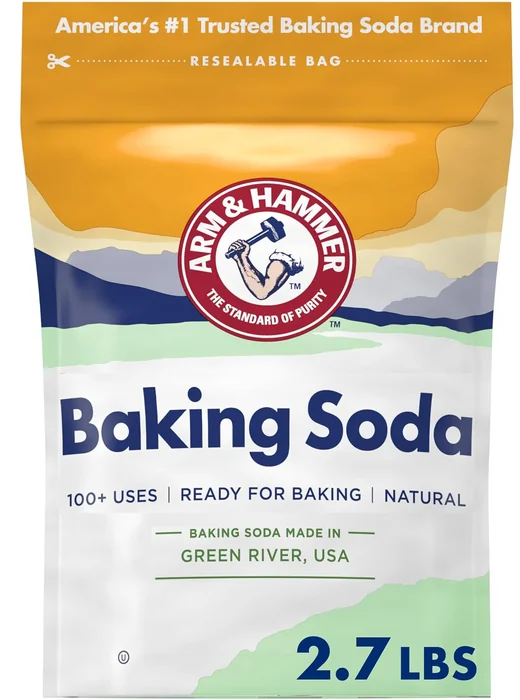
The 2.7-pound resealable bag of Arm & Hammer Baking Soda is the ordinary pantry product, with the same Drug Facts antacid directions described above. As of October 8, 2026, Amazon.com's own offer was in stock at $7.99 ($0.18 per ounce), and the item is listed as non-returnable for food-safety reasons. Third-party sellers also offer it on the same listing and can hold the default Buy button, so check who the seller is before you order. We're linking it for its real uses, not for the "trick."
Plain link: amazon.com/dp/B0CJCXLDSP. As an Amazon Associate, The Living Well Guide earns from qualifying purchases. See our Disclosure page for details.
Where this comes from
Sourced from the International Society of Sports Nutrition position stand on sodium bicarbonate and exercise performance, 2021 (PubMed); a systematic review and meta-analysis of sodium bicarbonate and muscular strength and endurance, Sports Medicine, 2020 (PubMed); a systematic review and meta-analysis of single-dose sodium bicarbonate and continuous running performance, 2025 (PubMed); a comprehensive meta-analysis of extracellular buffering supplements, Sports Medicine, 2022 (PubMed); a randomized trial of oral bicarbonate supplementation in adults with reduced kidney function, Journal of the American Society of Nephrology, 2009 (PubMed); a review of body acid-base state and glucose regulation in humans, European Journal of Clinical Nutrition, 2020 (PubMed); medical-toxicology case files on baking soda, Journal of Medical Toxicology, 2013 (PMC); a case report and systematic review of sodium bicarbonate toxicity, American Journal of Emergency Medicine, 2026 (PubMed); the FDA's consumer page on sodium in the diet (FDA); the federal antacid labeling regulation, 21 CFR 331.30 (Cornell LII); the NIH MedlinePlus drug entry for sodium bicarbonate (MedlinePlus); the Arm & Hammer Baking Soda Drug Facts label filed with the NIH's DailyMed, revised April 2026 (DailyMed); local news coverage of the Better Business Bureau's August 2026 warning on AI-generated supplement ads (WGEM); and a consumer-protection column on deepfake online health scams, April 2026 (Greenfield Recorder). Sales pages and label read-throughs for three "baking soda" funnel products were checked (one opened directly on October 7, 2026; two from label reviews conducted in September 2026); by policy we don't link to them. Summarized here in plain language; not a substitute for reading the original research or talking to a healthcare provider about your own situation.
Content on this site is for general informational purposes only and is not medical advice. It is not intended to diagnose, treat, cure, or prevent any disease or condition. Talk to a healthcare provider before starting any new supplement or making a significant change to your diet or routine, especially if you're pregnant or nursing, take other medications, or manage a chronic digestive, kidney, or heart condition.